The world is winning on the income statement and losing on the balance sheet.
For most of the past century, nations have been measured the way a sales team is measured. How much did we produce this quarter? How fast did we grow this year? GDP, the headline number every government chases, is an income statement. It tells you what flowed through the economy. It tells you almost nothing about what was built, what was depleted, or what was owed.

Why we are writing about this
Roger Ohan, the author of The Ledger, sits on the STELLR Global advisory board. He spent more than thirty years in global financial markets, including a long career at JPMorgan Chase where he became a Managing Director, before moving into asset management and advisory work with major banks worldwide. When someone with that vantage point publishes their first book, we read it carefully. This piece is our reading of the argument.
A different way to read a country
In the summer of 2005, Hurricane Katrina destroyed the city of New Orleans. This was a catastrophe for the residents of New Orleans, whose lives were destroyed. But if you looked at the GDP, it didn't show a catastrophic loss. GDP counts activity, and there was a lot of activity to rebuild the city. But if you had looked at New Orleans' balance sheet, it would have shown a huge writedown.
The GDP is the income statement which tracks activity, but the balance sheet isn't generally disclosed. GDP is perfect for looking at short term movements, but to be sure the country is heading in the right direction, you need to look at the changes in the balance sheet.
No governments communicate this way. No electorate is trained to demand it. The result is that policy choices that look strong on quarterly output often look very different when you ask what they did to the underlying capital base. Infrastructure aging faster than it was replaced. Natural capital drawn down without being booked. Pension and entitlement obligations growing on the liabilities side while the conversation stays focused on growth.
Net GNA, the Sovereign Share and the Governance Premium
This is the territory that Roger Ohan, who spent more than three decades at the heart of global financial markets and now sits on the STELLR Global advisory board, opens up in his new book, The Ledger. The book introduces a vocabulary that the public conversation has been missing.
Net GNA, or Net Gross National Assets, asks the obvious question that GDP refuses to answer. After you account for what was depreciated, depleted, and the increase in debts, is the country actually worth more or less this year compared to last. The Sovereign Share reframes ownership. What is each citizen's stake in the assets and liabilities of their country? The Governance Premium acts as a multiplier for each country's assets.
None of these are abstract. They show up in capital flows, in bond spreads, in where founders register companies, in where families park wealth across generations. They are already shaping decisions. They are simply not yet shaping the headlines.
The AI Shadow on the balance sheet
Layer artificial intelligence on top of this and the picture sharpens. AI is, in income statement terms, a productivity miracle. It compresses cost, accelerates output, and flatters margins. In balance sheet terms it is something more complicated. It concentrates value in a small number of platforms, model providers, and infrastructure owners. It quietly rewrites who owns the means of production for an entire layer of knowledge work.
If you only watch the income statement, AI looks like growth. If you read the balance sheet, AI looks like one of the largest transfers of productive capital in modern history. Both are true at the same time. Only one of them is being priced into public conversation.
Why this matters beyond economics
The shift from income statement thinking to balance sheet thinking is not a niche debate for macro economists. It is the lens that increasingly explains why citizens feel poorer in countries whose GDP keeps rising, why investors quietly reprice entire regions, why talent migrates toward jurisdictions with stronger institutions even when the headline growth is elsewhere.
It is also the lens that any serious leader, whether founder, investor, policymaker, or operator, will need in order to make decisions over the next decade. Optimising for the next reported quarter while the underlying capital base erodes is the corporate equivalent of running a great sales month in a business with no equity left.

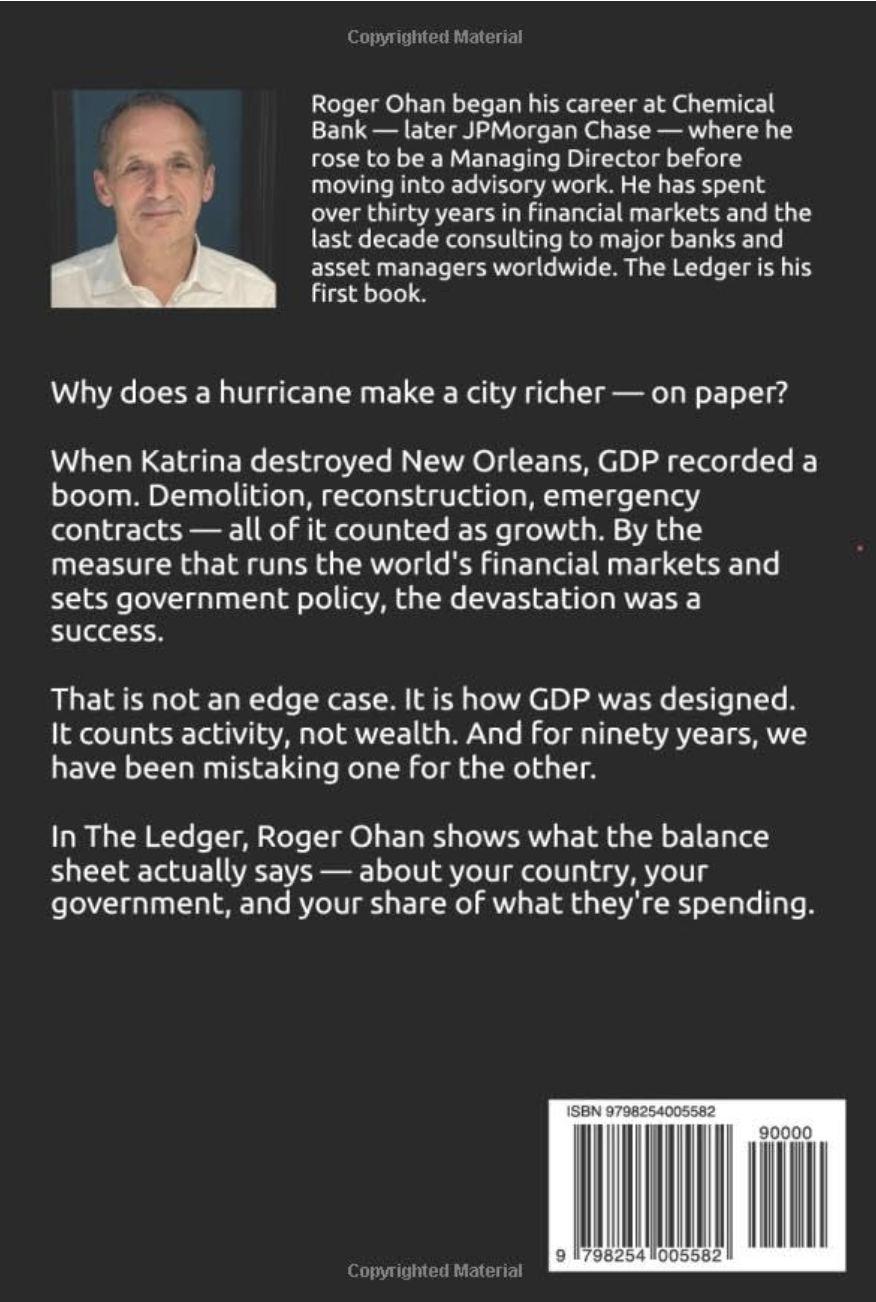
Buy The Ledger by Roger Ohan on Amazon here.